
Pelvic floor exercise to prevent urinary incontinence

Updated: Dec 23, 2025
Great video with step by step instructions on Kegel and pelvic floor toning to help with urinary incontinence, pelvic floor pain or dysfunction.
How to Strengthen Your Pelvic Floor: 3 Essential Exercises for Bladder Control
Urinary incontinence and pelvic floor dysfunction are common issues, but they don’t have to be your "new normal." Strengthening the pelvic diaphragm—the hammock-shaped muscle group that spans from your pubic bone to your tailbone—is key to preventing leaks and improving pelvic health.
In this guide, based on demonstrations by Dr. Natalie Stratton, DPT, we break down how to perform a proper Kegel and two additional hip-focused exercises that complete your pelvic floor routine.
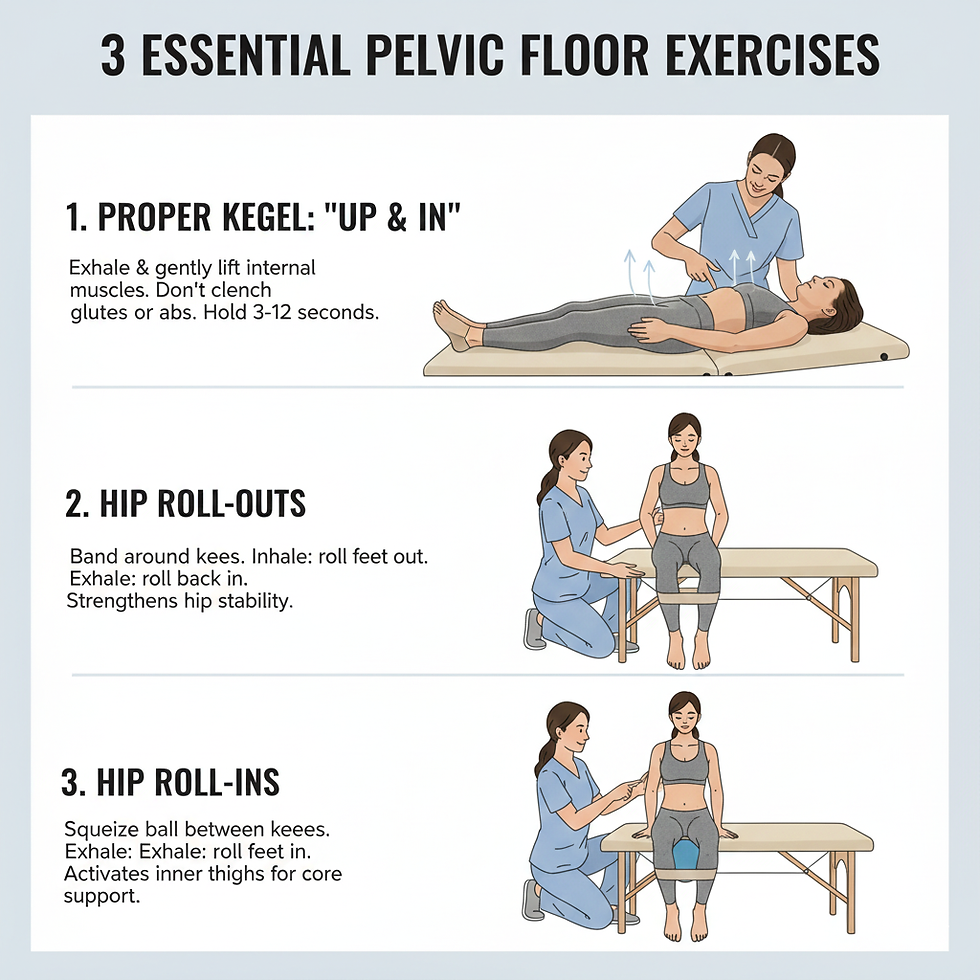
1. The Proper Kegel: "Up and In"
Did you know that up to 99% of people perform Kegels incorrectly? [00:42]. The secret is coordination with your breath.
The Technique: Inhale fully. As you exhale, pull "up and in" around the vaginal area. Imagine lifting the muscles away from your clothes [00:58].
The Check: You should not feel your abdominals, glutes, or thighs clenching. It should be strictly the internal pelvic muscles [01:14].
The Test: You must be able to breathe or count out loud while holding the contraction. If you have to hold your breath, your abdominal diaphragm isn't working correctly with your pelvic floor [02:17].
The Routine: Practice 3-second holds (10 reps, 3x daily) and longer 12-second holds (10 reps, 3x daily) [03:07].
2. Hip Roll-Outs (Obturator Internus Strengthening)
The pelvic floor doesn't work in isolation; it’s connected to your hip muscles. Strengthening the obturator internus helps provide a stable foundation for the pelvic diaphragm [03:42].
Setup: Use a resistance band (TheraBand) tied around your knees while sitting with your feet and heels together [04:13].
The Move: Keeping your feet on the floor, roll your feet out so your knees and hips follow, then roll back in.
Breathing: Inhale as you roll out, and exhale as you roll back in [04:41].
3. Hip Roll-Ins (Adductor Strengthening)
The inner thigh muscles (adductors) also play a role in pelvic stability.
Summary
Consistency is key. Start these exercises lying down, and once you’ve mastered the technique, move to a seated position [03:29]. By targeting the pelvic diaphragm, the hips, and the inner thighs, you can significantly reduce pelvic pain and incontinence issues.


The chamber is looking like a box more room where you sit and make deals with a person and listen their problems. By other of the tile removal tools it is also very expensive to buy and also very easy to run